When I first started budgeting, I thought I had to get everything perfect.
Spreadsheets, percentage rules, rigid categories — the works. But no matter how many plans I made, something always knocked me off track. A forgotten subscription. A surprise night out. Or just plain fatigue.
Eventually, I realised something that changed everything:
Tracking your spending is more powerful than creating the “perfect” budget.
Here’s why focusing on awareness — not perfection — can completely change how you manage your money.
Budgeting Without Tracking Is Like Driving With Your Eyes Closed
You can make a flawless monthly budget…
But if you’re not tracking where your money actually goes, that budget becomes a guess — not a tool.
Tracking your spending brings clarity, and with clarity comes control.
It lets you ask:
- “Why do I always overspend halfway through the month?”
- “What subscriptions am I paying for but not using?”
- “Is my food budget really realistic — or just wishful thinking?”
You can’t adjust what you don’t measure.
The Psychology: Why Awareness Changes Everything
Most people don’t overspend because they’re reckless — they overspend because they’re unaware.
When you track your spending:
- You see where your money goes in real time
- You spot patterns that don’t align with your goals
- You make more conscious decisions — even before you swipe your card
In psychology, this is called behavioural feedback. When you get real-time feedback on your actions, your brain naturally starts to self-correct. Tracking activates that.
My Turning Point: The £4 Here, £6 There Trap
When I was in the thick of my debt journey, I didn’t think I spent much on “non-essentials.”
But when I started tracking everything — literally every pound — I noticed something. I was spending £4 here, £6 there, £8 on “just one treat.” Over the month, it added up to over £150. Not on big purchases, but on moments I barely remembered.
That’s when it hit me: I didn’t need a tighter budget. I needed a better understanding of my habits.
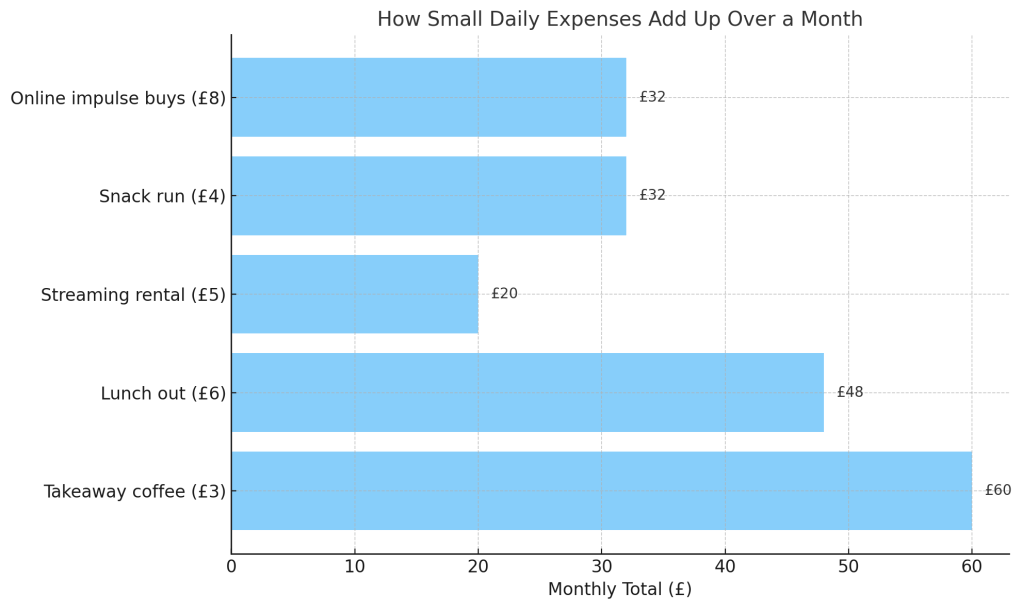
Here’s a visual showing how small daily expenses add up over the course of a month:
- Takeaway coffee: £60/month
- Lunch out: £48/month
- Streaming rental: £20/month
- Snack runs: £32/month
- Online impulse buys: £32/month
That’s £192/month on things many people barely notice.
What You Should Track (Even If It Feels Boring)
You don’t need a fancy system. Just consistency.
Start by tracking these:
- Every single transaction — no matter how small
- Cash, card, and online payments
- Recurring subscriptions and bills
- Unplanned expenses (they tell you where to adjust next)
Apps like Pocketsmith, Emma, or even a simple spreadsheet work well. Use whatever you’ll actually stick with.
Don’t Let Imperfection Stop You
You’re going to miss a receipt. Forget a £1 charge. Get tired of logging your lunch. That’s okay.
Tracking isn’t about being flawless — it’s about building awareness over time.
Even if you only track 80% of your spending, you’ll learn more about your habits than you ever would from a perfectly structured but disconnected budget.
Final Thoughts
A budget is a plan.
Tracking is what makes that plan real.
If you’ve struggled to stick to a budget, don’t give up. Shift your focus. Start by simply tracking where your money goes — with honesty, not shame.
Once you can see it, you can change it.
 Pennywise Path
Leave a comment